
Smarter by Design.Simpler for Business
Dictionaries (Multilingual)
What Are Dictionaries (Multilingual)?
Dictionaries (Multilingual) are the profiles that keep the languages to be used on the access pages of a vService with AGS enabled and the translation texts in these languages. In the dictionary first the supported languages are selected (the first language is the default language), and then for each Translation Key a value is entered in each of the supported languages.
The dictionary alone does not bring a text to the page; where the text is shown is determined on the Page Templates and Login Forms screens. When Dictionary is selected as the type in the text fields on these screens and exactly the same key as the Translation Key in the dictionary is written, the text comes from the dictionary selected for the vService according to the language of the user.
The dictionary is selected from the Dictionary field in the AGS settings of the vService; each vService uses a single dictionary. Two built-in dictionaries come with TR7 (Default Dictionary: all the languages of the catalog, English Only: only English); neither contains a translation row, and the standard texts of the access pages (login, password, submit, cancel…) come from TR7's built-in ten-language catalog. The built-in dictionaries do not appear in the list of this screen, they are selected directly in the selector in the vService settings.
10
Language Catalog
English, Türkçe, Español, Deutsch, Русский, Français, Português, 中文, 日本語, العربية
Key × Language
Translation Table
A value that supports smart variables in each of the supported languages for each key
Dictionary
Text Type
The Page Templates and Login Forms texts are bound to the dictionary with a key
2
Built-in Dictionaries
Default Dictionary · English Only (they do not appear in the list, they are selected in the vService setting)
How does it work?
- The dictionary is defined on this screen: the languages are added to the Supported Languages list (the first language is the default language), and a Translation Key is added to the Translations section and a value is entered for each language.
- On the Page Templates or the Login Forms screen the type of the related text field is selected as Dictionary and the same key is written.
- In the AGS settings of the vService the dictionary is selected from the Dictionary field and the template from the Page Template field.
- When the access page is opened, the key is searched for in the dictionary of the vService and the value belonging to the language of the user is shown.
Built-in Dictionaries
| Dictionary | Supported Languages | Translations |
|---|---|---|
| Default Dictionary (the vService default) | The ten languages of the catalog | None (the built-in texts are used) |
| English Only | English | None |
Since the built-in dictionaries are not in the list, they are not edited or deleted from this screen.
Operational Best Practices
- The key exactly the same. The key written in Page Templates and Login Forms must be letter for letter the same as the Translation Key in the dictionary; a key that is written differently is not found in the dictionary.
- The template and the dictionary on the same vService. The key is searched for in the dictionary selected for the vService; the keys the template uses must be defined in the dictionary in the Dictionary field of that vService.
- No language outside the catalog. The supported languages are limited to the ten-language catalog; when a record that contains a language code outside the catalog is opened on this screen, that language and its translations drop from the form and are lost when it is saved.
- The first language is the default. The language cards are ordered by dragging; the language in the first place is marked as (Default) and this language is expected to be used when the language of the user does not match.
- The key naming. The keys have to start with a letter and contain letters, digits and underscores (e.g.
footerCopyright). - A value for each language. When a key is added, an empty row is opened for each supported language; the values that are left empty go as an empty text in that language.
- A backup before removing a language. When a language is removed from the list, all the translation rows belonging to that language are deleted from the form.
- The vServices before deleting. The delete confirmation does not show the usage locations; the vServices that use the dictionary must be checked on the Used in tab in the preview.
How to Add?
A new Dictionaries (Multilingual) profile is added through the TR7 web management interface with the following steps:
- The Configuration Menu is opened by clicking the TR7 logo at the bottom left.
- The AGS → Pages & Language → Dictionaries (Multilingual) → Add steps are followed.
- A unique and descriptive name is entered for the profile.
- The languages are added to the Supported Languages list; the keys and the values for each language are entered in the Translations section.
- The profile is added by clicking the
Addbutton.
TIP
Reaching the page via quick search
Instead of navigating the menu step by step, the related page is reached directly by using the search bar in the bottom left corner of the screen. The search bar opens with the Alt + T shortcut on Windows and Opt + T on macOS; typing the name of the feature being searched for is then sufficient.
The created profile is used in the Dictionary field of one or more vServices with AGS enabled. The profile is also defined without leaving the vService settings with the add icon next to this field; the created profile comes selected in the field.
Dictionaries (Multilingual) Listing Screen
The list of all Dictionaries (Multilingual) profiles that are added on the TR7 device is reached by following the AGS → Pages & Language → Dictionaries (Multilingual) path. Profile adding, editing and deleting operations are performed on this screen. The built-in dictionaries are not listed.
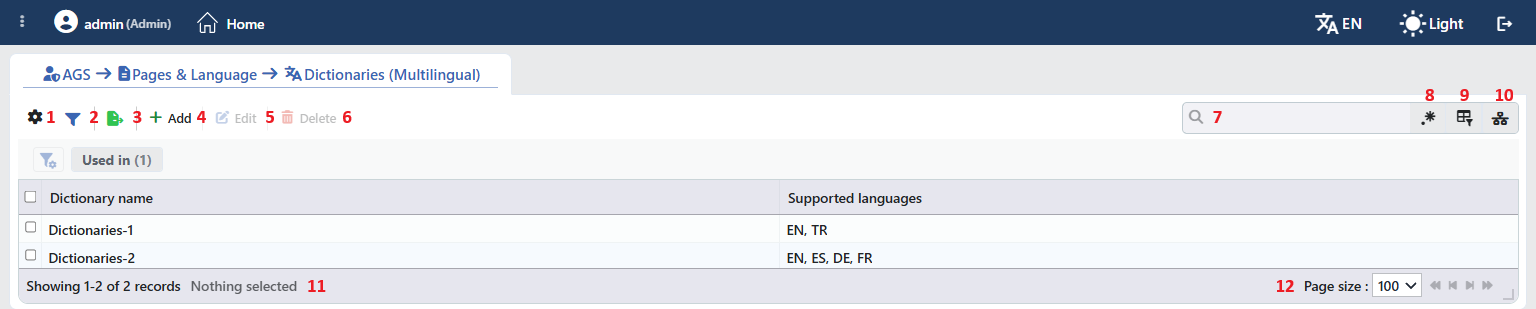 Dictionaries (Multilingual) Profiles Listing Form
The table opens with the following columns by default:
| Column | Description |
|---|---|
| Dictionary Name | The name of the profile. |
| Supported Languages | The codes of the supported languages, in uppercase and in order (e.g. EN, TR); the first code is the default language. When the column header is clicked, the sorting is made by the number of languages. |
There is no column that is hidden by default. The table is not sorted when it opens; when a column header is clicked, first a descending and then an ascending sort is applied, and on the third click the sort is removed.
The items in the toolbar are arranged from left to right in the following order; the last two items (Page Information and Page Size) are located in the information strip below the table.
Columns
Which columns are shown in the table is selected; both of the columns come on. In the same panel the columns are reordered by dragging and the alignment is selected per column; the row height is fitted to the page with the Fit rows to the page button and the column layout is returned to the default with the Reset button. When the width badge next to a manually widened column is clicked, the column returns to the automatic width.
Filter
The Filter button is used to filter the profiles shown in the list according to certain criteria. There is a single card in the filter strip; the number next to the card name shows how many different values are found for that card in the profiles in the list:
| Card | What it filters |
|---|---|
| Used in | The vServices that use the profiles and the Unused Entries value, which lists the profiles that are not used anywhere. |
Export
The table is exported as Excel, CSV or PDF by clicking the Export button. In the window that opens, the Filename, Format and Data Source, together with the Columns to be exported, are determined; the remaining fields are displayed according to the format: CSV Separator for CSV, Excel Sheet Name for Excel, and Page Orientation and Page Size for PDF.
Add
By clicking the Add button, the form for creating a new profile opens in the Add tab.
Edit
By clicking the Edit button, the edit form of the selected profile opens in the Edit tab. The button becomes enabled only when a single profile is selected.
The edit form is the same as the add form; all the fields including the name are changed and the button at the bottom of the form carries the name Edit. The change is saved without asking for confirmation and the configuration of the vServices that use the profile is applied again.
Delete
When one or more profiles are selected and the Delete button is clicked, the related profiles are deleted. Before deleting, the "Are you sure?" confirmation is asked for.
WARNING
A profile that is in use can also be deleted and the confirmation window does not show the usage locations.
The Dictionary reference is not cleared automatically on the vServices that use the profile; since the dictionary cannot be found, no translation is written into the pages of these vServices. When the AGS settings of the vService are opened again, the invalid selection returns to Default Dictionary and this value is written when it is saved. The delete operation is written to the user operation record.
Search
Used to search all information in the table.
RegExp Search
Used to search all the information in the table with a regular expression (RegExp). While the column-based search or the usage filter is active, this button is hidden.
Column Based Search
Used to perform a column-based search on the information in the table.
Usage Filter
Used to filter to which vServices the profiles are bound. While the filter is active, a selector takes the place of the search box; when the icon is clicked again, the search box returns.
Page Information
Contains information about the total number of defined profiles and the number of profiles displayed in the list: Showing N-M of T records and the number of selected profiles (N selected, or Nothing selected when there is no selection).
Page Size
The maximum number of profiles to be displayed on the page is selected. On this screen the default is 100; the options are 5, 10, 20, 50, 100, 200, 500 and All.
Right-Click Menu
When a row is right-clicked, a menu with the profile's name in its title opens. Both operations in the menu apply only to the right-clicked profile; a selection made in the list does not affect the menu.
| Operation | What it does |
|---|---|
| Edit | Opens the editing form of the profile in the Edit tab; it is the same as the form opened by the Edit button in the toolbar. |
| Delete | Deletes the right-clicked profile; the same confirmation question as the deletion in the toolbar is displayed. |
Preview of the Selected Profile
When a row in the list is clicked, the preview of the profile opens on the right of the screen; when the selected row is clicked again, the panel closes. The header contains the language icon, the name of the profile and the Dictionary subtitle, and the single operation is at the top right.
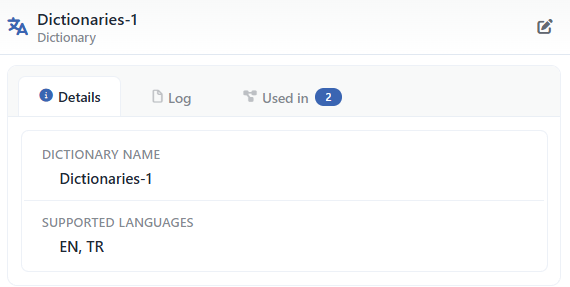 Preview of the Selected Profile
| Operation | What it does |
|---|---|
| Edit | Opens the editing form of the profile in the Edit tab. |
There are three tabs in the panel; Used in is displayed only if the profile is used on at least one vService:
Details
Lists the settings of the profile row by row (the table below).
Log
Lists the user operations on the profile (adding, editing, deleting) as a timeline.
Used in
Lists the vServices that use the profile. The badge next to the tab name shows the usage count.
The rows in the Details tab are as follows, in order:
| Row | Description | Visibility condition |
|---|---|---|
| Dictionary Name | The name of the profile. | Always |
| Supported Languages | The language codes in uppercase, with commas (e.g. EN, TR). | Always |
| Translations | The number of translation rows (the key × the language). | If there is at least one row |
Profile Add Form
A new Dictionaries (Multilingual) profile is added on the TR7 device by following the AGS → Pages & Language → Dictionaries (Multilingual) → Add steps.
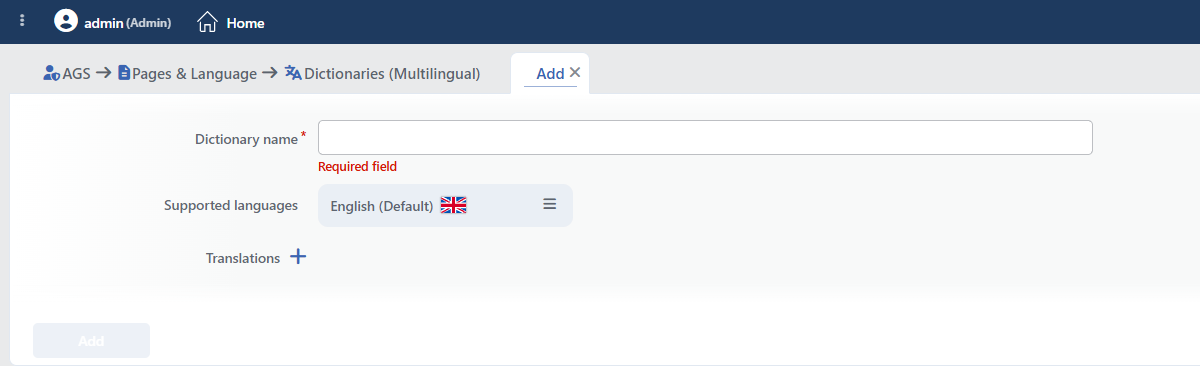 Dictionaries (Multilingual) Profile Add Form
INFO
Dictionary Name Required
The name of the profile; it identifies the profile in the selection in the vService settings and in the logs. The name must be unique on the device; a second profile with the same name is not saved and the Name is used warning is displayed. When it is left empty, the Required field warning is displayed.
INFO
Supported Languages Default: English
The card list of the supported languages; the cards are displayed in a three-column grid and are ordered by dragging. Each card shows the language name and its flag; the first card is the default language with the (Default) suffix. The list cannot be left empty.
There are three operations in the menu on the right of the card:
| Operation | Meaning |
|---|---|
| Change Language | The language of the card is changed with the language selector window that opens; the translation rows belonging to that language are moved to the new language. |
| Delete Language | The language is removed from the list after a confirmation; the translation rows belonging to that language are deleted as well. It is inactive when a single language is left. |
| Add Language | A language is selected in the window headed Change Language and the card is added to the end of the list; the first language that is not used comes preselected. It is inactive when all ten languages are used. |
The languages that can be selected: English, Türkçe, Español, Deutsch, Русский, Français, Português, 中文, 日本語 and العربية.
INFO
Translations
The list of the translation keys. A new key is added with the + icon next to the Translations label (Add translation key); in the window that opens the key name is entered and an empty value row is created for each supported language.
Translation Key
The name of the key; it starts with a letter and contains letters, digits and underscores. When a name that does not comply with this rule or that is already in the dictionary is entered, a warning is displayed and the operation is undone. The key written with the Dictionary type in Page Templates and Login Forms matches this name. It is displayed in the block header in the Translation key: key form; it is renamed in place with Edit in the menu or by double-clicking the header (Enter or leaving the field confirms, Esc cancels). Delete in the menu deletes the key together with all its languages, after a confirmation.
The Value Rows
There is a row with a flag for each supported language. The value is entered into a text box that supports smart variables; a smart variable is added with the ƒx icon and the variable is resolved at request time. The same key-language pair is not saved twice in the form.
INFO
Add
The profile is added by clicking the Add button; the tab closes and the profile is displayed in the list.
Example Usage
In the example below the copyright text in the footer of the access pages is shown in ten languages. The footerCopyright key is defined in the dictionary and a value is entered for each language; the Year smart variable in the values turns into the current year when the page is opened.
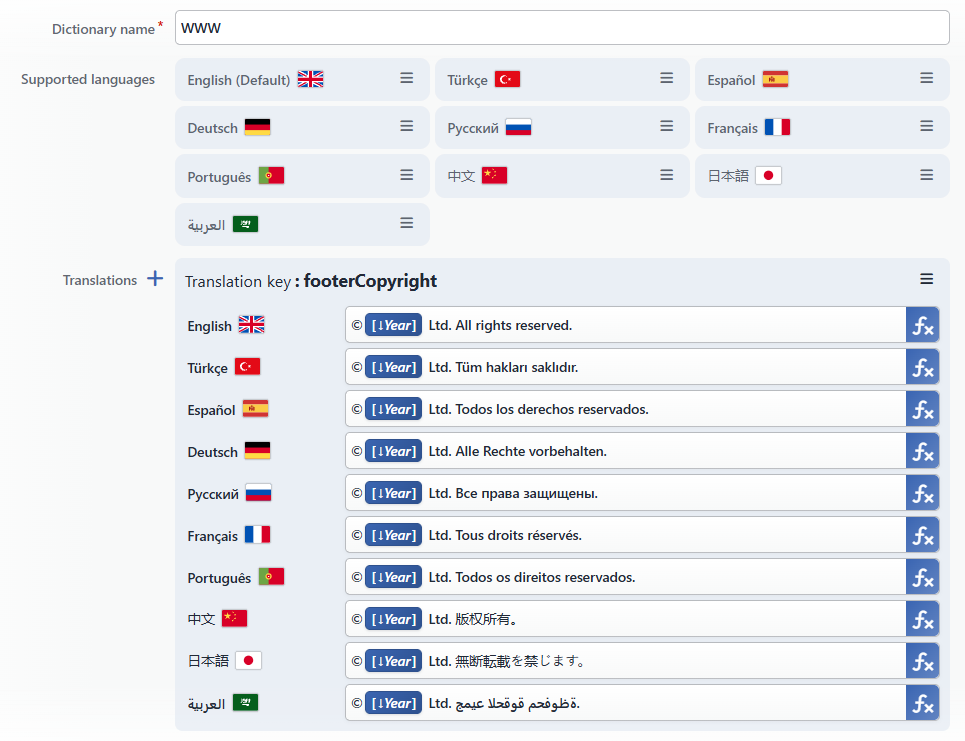 Example Usage: The footerCopyright Key
The following steps are followed for the key to be displayed on the page:
- The dictionary is created on this screen; the languages are added to the Supported Languages list and the
footerCopyrightkey and the value of each language are entered in the Translations section. - On the Page Templates screen the Footer Enabled switch of the template is turned on (the Footer Content field is displayed only while this switch is on), Dictionary is selected as the type in the Footer Content field and
footerCopyrightis written into the key box. The key must be exactly the same as the Translation Key in the dictionary. - In the AGS settings of the vService this dictionary is selected from the Dictionary field and this template from the Page Template field.
- When the access page is opened, the value belonging to the language of the user is displayed in the footer: a user who uses Turkish sees the text "© 2026 Ltd. Tüm hakları saklıdır." and a user who uses German the text "© 2026 Ltd. Alle Rechte vorbehalten."
If the key does not match
If the key written in Page Templates is not found in the dictionary selected for the vService, the text does not come from the dictionary. The spelling of the key and that the correct dictionary is selected in the Dictionary field of the vService must be checked.
The same method is used in the Page Title and Header Content fields in Page Templates and in the title, label, placeholder, help, button, information text and divider text and the option texts on the Login Forms screen as well.
Operating Mechanism
INFO
- The text types. There are four types in the text fields in Page Templates and Login Forms: Static (a fixed text, supporting smart variables), Dictionary (a dictionary key), Default (the built-in text of TR7) and No Text (no text is shown). When Dictionary is selected, a key box takes the place of the text box.
- Distribution. The dictionaries are transferred to the access engines of the vServices with AGS enabled; TR7's built-in ten-language catalog is given to the engine separately as well. After a change the configuration is applied again.
- The translation values. The dictionary is given to the access engine of the vService. The translation values that contain a smart variable are additionally written into the common user dictionary of the vService as a template and are served over
<the AGS root path>/gw-files/user_dictionary.js(the default root path/ags-portal); the variables are resolved at request time. The plain text values do not enter the template, they are carried with the dictionary itself. - The language selection. The language matching is performed in the access engine; the language in the first place is marked as (Default) and, if there is no translation matching the language of the user, this language and, for the standard texts, the related language of the catalog are expected to be used.
- Cluster. The profiles are synchronized between the devices with the LB configuration.
- Logs. Adding, editing and deleting are monitored on the User Logs screen as the dictionary object.
Scope and Limits
INFO
- Permission. The AGS screens depend on the Load Balancer permission area; for a user who does not have the permission the You don't have access to this page card is displayed instead of the page.
- The name is unique. A second profile carrying the same name is not saved.
- The built-in dictionaries are not listed, they are not edited or deleted from this screen.
- A ten-language catalog. Language codes outside the catalog are not supported in the interface.
- A single dictionary per vService; the keys are searched for only in the dictionary selected for the vService. The Dictionary field in the vService settings cannot be left empty; a new vService comes with Default Dictionary.
- License. The screen requires the AGS license.
- There is no import/export; the translations are entered row by row in the form.
- Deleting does not perform a reference check; a profile in use is deleted as well.
Usage Locations
| Usage location | Field | Purpose |
|---|---|---|
| A vService with AGS enabled → AGS Management | Dictionary | The languages and the translations of the vService access pages; Default Dictionary on a new vService |
| Page Templates | The texts of the Dictionary type (Page Title, Header Content, Footer Content) | The template texts coming from the dictionary with a key |
| Login Forms | The texts of the Dictionary type (the title, the label, the placeholder, the help, the button) | The form texts coming from the dictionary with a key |
