
Smarter by Design.Simpler for Business
TR7Enterprise Application Delivery & Security Platform
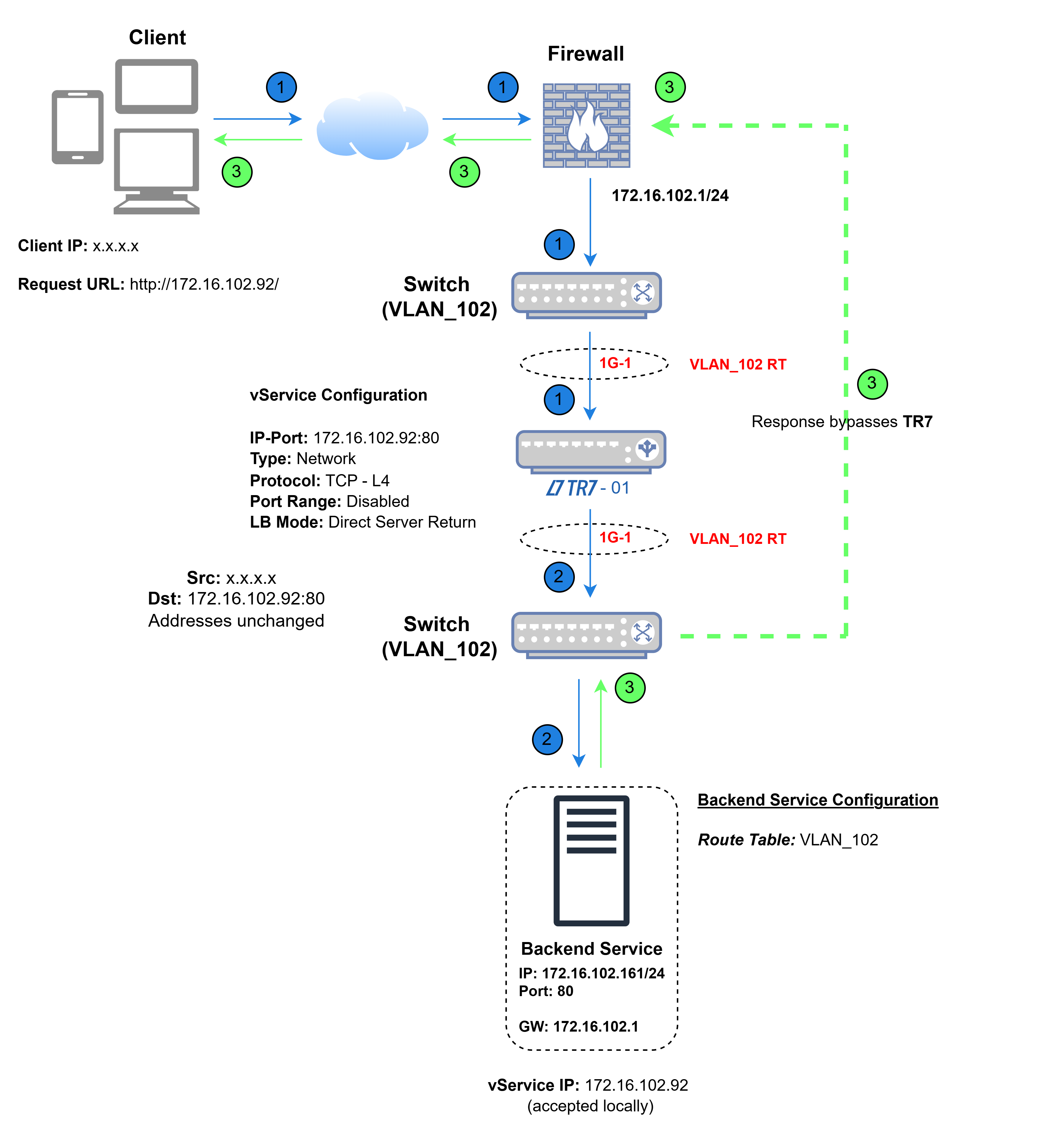
Direct Server Return is the deployment in which the request is distributed through TR7, while the response returns directly to the client without passing through TR7 (on the Network vService, the LB Mode field set to Direct Server Return; TCP - L4 or UDP - L4 as the Protocol, Port Range disabled; Backend Services on the same network as TR7 and prepared to accept the vService address). TR7 only decides which server the incoming traffic goes to; it does not touch the packet's addresses or content.
Because response traffic does not pass through the load balancer, TR7's capacity is dedicated to traffic coming from the client. For services whose responses are many times larger than their requests, this means carrying far more traffic with the same device. The client address also reaches the server without undergoing any translation.
Network vService only
This deployment operates at L4 and is set up with a Network vService. TLS termination, WAF, AGS, L7 DDoS and Bot protection, and X-Forwarded-For are not available on this vService type; if these layers are needed, the other deployments set up with an HTTP or L7 TCP vService are used.
 Direct Server Return
The diagram shows the traffic flow in a single-device installation in three steps: the vService address the client connects to (172.16.102.92:80), TR7 and the Backend Service are on the same interface (1G-1 in the diagram) and on the same network (VLAN_102 in the diagram). The request passes through TR7; the response, however, returns from the Backend Service to the gateway and from there to the client without passing through TR7 (dashed green line in the diagram).
In the diagram's example, TR7 forwards the incoming packet to the Backend Service it selects without changing its addresses: the packet's source remains the client's address (x.x.x.x) and its destination remains the vService address (172.16.102.92:80). The Backend Service is prepared to accept this address as its own address (vService IP, accepted locally in the diagram); it sends the response directly to the client via its own gateway (172.16.102.1), showing the vService address as the source.
The health check is performed from TR7 to the Backend Service's own address (172.16.102.161), not to the vService address.
In the diagram's example, the source and destination information of the packets in the three steps of the connection is as follows:
| Step | Direction | Source IP | Source Port | Destination IP | Destination Port |
|---|---|---|---|---|---|
| 1 | Client → TR7 | x.x.x.x (Client IP) | Random | 172.16.102.92 (vService address) | 80 |
| 2 | TR7 → Backend Service | x.x.x.x (Client IP) | Source port of step 1 | 172.16.102.92 (vService address); the packet is forwarded to the Backend Service without its addresses changing | 80 |
| 3 | Backend Service → Client (does not pass through TR7) | 172.16.102.92 (vService address) | 80 | x.x.x.x (Client IP) | Source port of step 1 |
| Color | Meaning |
|---|---|
| Request | |
| Response |
In steps 1 and 2 the packet is the same; TR7 only determines which Backend Service it goes to. The fourth step in the other deployments, that is, forwarding the response from TR7 to the client, does not exist in this deployment.
| Deployments where the response also passes through TR7 | With Direct Server Return |
|---|---|
| Both the request and the response pass through the load balancer; the device carries the traffic of both directions. | TR7 only distributes the incoming request; the response goes directly from the server to the client. |
| Large responses (media, files, streaming) consume the load balancer's capacity. | Response data does not pass through TR7; the load on TR7 remains limited to packets coming from the client. |
| The source address is translated, or the return path is provided separately. | The address is not translated; the server sees the client directly and sends the response directly to it. |
| On HTTP and L7 TCP vServices, every connection is terminated on TR7 and processed at the application layer. | Packets are forwarded without being opened; TR7 adds no latency on the response path. |
In this deployment, TR7 is not an inspection point but a distribution point: its job is to select the right server and get out of the way. This is why it is preferred for services where speed and volume come first.
For services such as media streaming and file distribution, where the response is very large compared to the request, return traffic does not occupy the load balancer.
For services where every millisecond matters, such as real-time game servers and live broadcasting, the response reaches the client by the shortest path.
Infrastructure services that work with short and numerous packets are distributed to more than one server without being opened at the application layer.
Requirements and limits of this deployment